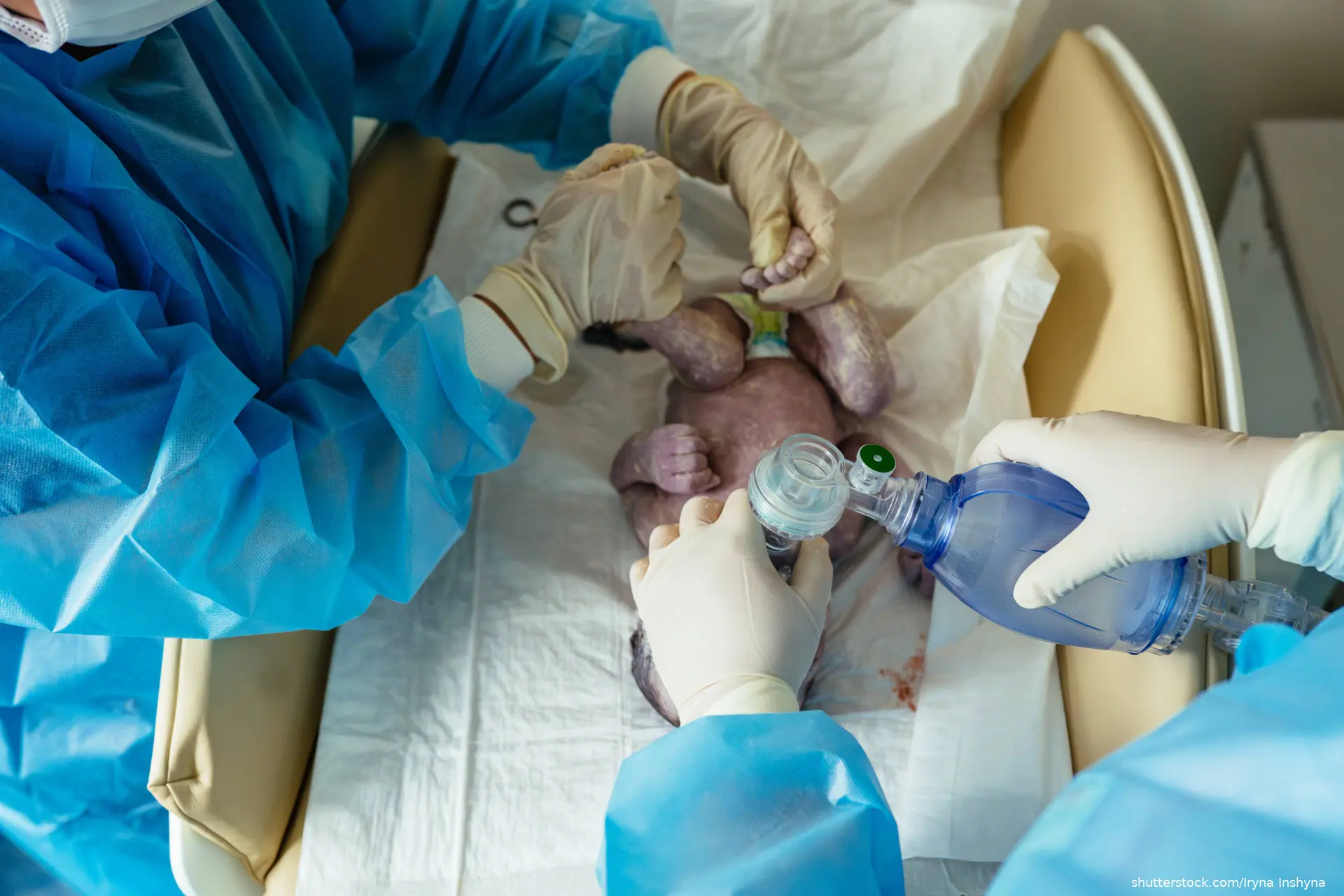
Starting delivery-room resuscitation with a fraction of inspired oxygen (FiO₂) of 0.30 rather than 0.21 did not reduce ongoing respiratory support at delivery-room exit among moderate- to late-preterm infants, according to the AIROPLANE cluster randomized crossover trial published in JAMA.
The unblinded trial enrolled 1,818 eligible newborns at 26 Australian maternity hospitals. Participants were born at 32 to 35 weeks’ gestation, had no known major congenital anomalies, and began respiratory support within 3 minutes of birth. Hospitals were assigned to use an initial FiO₂ of 0.30 or 0.21 during the first 3 minutes of support, then crossed over halfway through recruitment. The primary outcome was ongoing respiratory support when the infant left the delivery room.
Of 964 newborns assigned to FiO₂ 0.30, 700 (72.6%) remained on respiratory support at delivery-room exit, compared with 626 of 854 newborns (73.3%) assigned to FiO₂ 0.21. The risk difference was −0.83 (95% CI, −4.33 to 2.67), indicating no significant difference.
Two of 12 secondary outcomes differed significantly. Newborns assigned to FiO₂ 0.30 were less likely to receive higher levels of delivery-room support, including noninvasive positive pressure ventilation, endotracheal or supraglottic airway ventilation, or cardiac compressions or epinephrine (proportional odds ratio, 0.70; 95% CI, 0.52-0.95). Endotracheal ventilation beyond the delivery room occurred in 61 of 959 newborns (6.4%) in the FiO₂ 0.30 group and 79 of 852 (9.3%) in the FiO₂ 0.21 group (risk ratio, 0.69; 95% CI, 0.47-0.91).
The other 10 secondary outcomes did not differ significantly between groups. The investigators concluded that, among neonates born at 32 to 35 weeks’ gestation, an initial FiO₂ of 0.30 did not change the proportion still receiving respiratory support on leaving the delivery room compared with FiO₂ 0.21.
Source: Peart SR, Manley BJ, Cheong JLY, et al. Oxygen vs air at birth for moderate- to late-preterm infants: the AIROPLANE cluster randomized crossover trial. JAMA. Published online September 9, 2026. doi:10.1001/jama.2026.14201
Advertisement
Today's Joke
Cartoon Slide Show

Quiz
Medical Trivia 9/9/2026
1 questions · ≈ 1 min
to compete in the ranking.
×
Loading