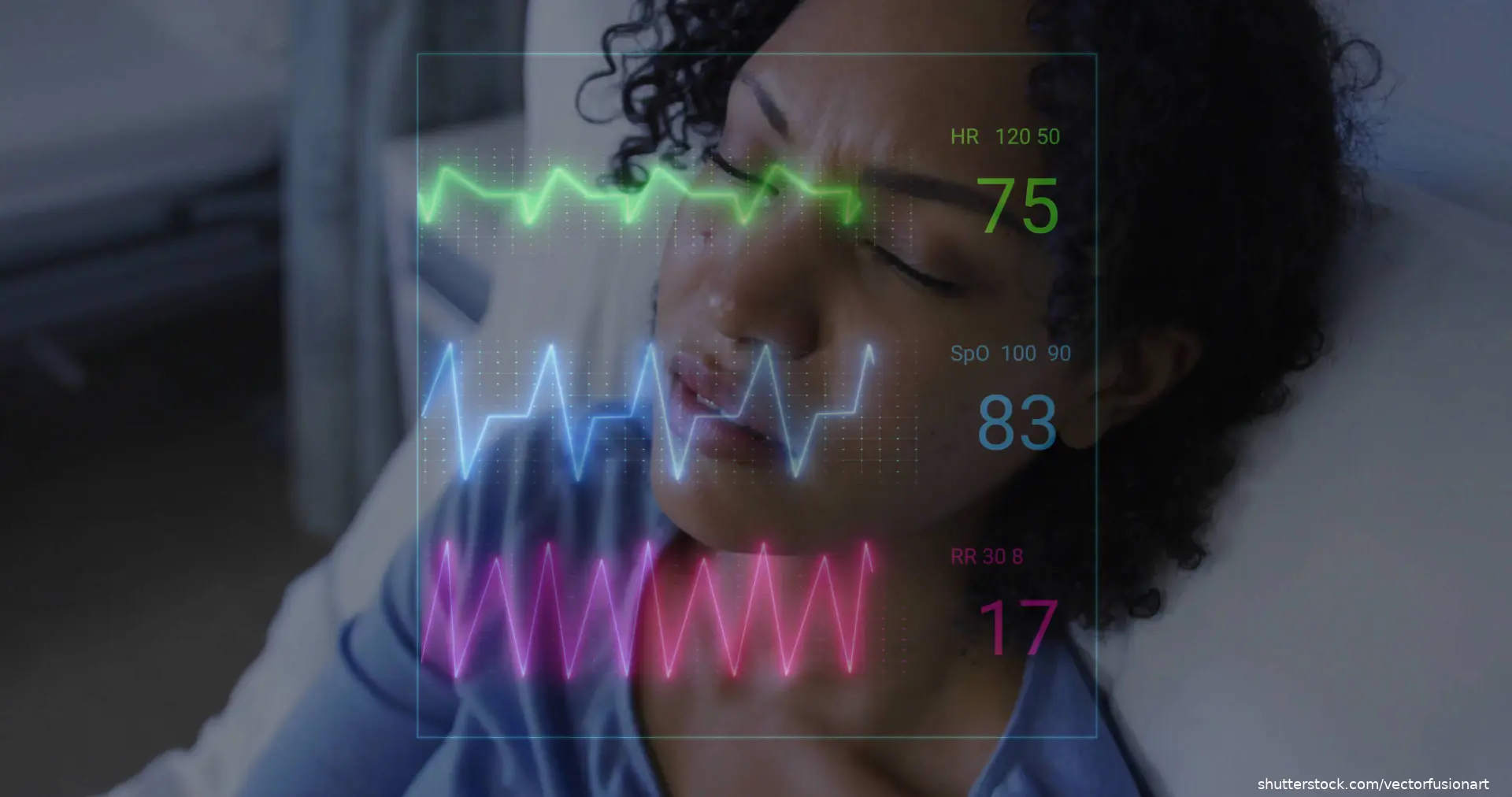
Sleep-Stage Patterns Identified SDB and Predicted Long-Term Cardiovascular Risk
A study published in Scientific Reports evaluated whether sleep-stage architecture and dynamics could identify moderate-to-severe sleep-disordered breathing (SDB) and predict long-term cardiovascular events.
Using prospective Sleep Heart Health Study data, investigators focused on 2,579 participants. Participants had no prior cardiovascular events and were not using sleep-altering medications. During follow-up of up to 15 years, 326 participants experienced a composite cardiovascular event. The outcome included angina, myocardial infarction, heart failure, coronary revascularization, and stroke.
A random forest classifier used 34 predictors spanning sleep-stage transitions, sleep macrostructure, demographics, body mass index, and smoking status. In 5-fold cross-validation, it distinguished an apnea-hypopnea index (AHI) greater than 15 from an AHI of 15 or less with an area under the receiver operating characteristic curve (AUROC) of 76.1%, sensitivity of 46.8%, and specificity of 84.7%. In the Bern Sleep-Wake Registry, AUROC was 76.0%, sensitivity was 42.8%, and specificity was 86.1%.
Random survival forest models predicted future cardiovascular events similarly whether AHI was included or omitted. With and without AHI, respectively, C-index values were 73.0% and 73.3%, 10-year time-dependent AUROC values were 75.1% and 75.3%, and integrated Brier scores were 6.7% for both. In primary-cohort comparisons, discrimination was comparable with office- and laboratory-based Framingham Risk Scores. Mean 10-year predicted-minus-observed risk errors were 0.80 and 0.62 percentage points for the sleep-based model, versus 3.64 and 1.85 points for the corresponding Framingham models.
Partial-effect analyses showed predominantly U-shaped associations between several sleep measures and model-predicted cardiovascular risk. The authors cautioned that these were predictive associations, not causal effects. They also noted limited transferability to clinically complex populations. The pooled cardiovascular composite could also obscure outcome-specific patterns. Because the external registry lacked standardized longitudinal cardiovascular time-to-event data, it primarily validated SDB detection rather than cardiovascular risk prediction.
Source: Bechny M, Scutari M, Tomita Y, et al. Sleep-stage dynamics predict current sleep-disordered breathing and future cardiovascular risk. Sci Rep. Published online September 2, 2026. doi:10.1038/s41598-026-69352-2
Advertisement
Today's Joke
Cartoon Slide Show
Quiz

Medical Trivia 9/9/2026
1 questions · ≈ 1 min
to compete in the ranking.
×
Loading