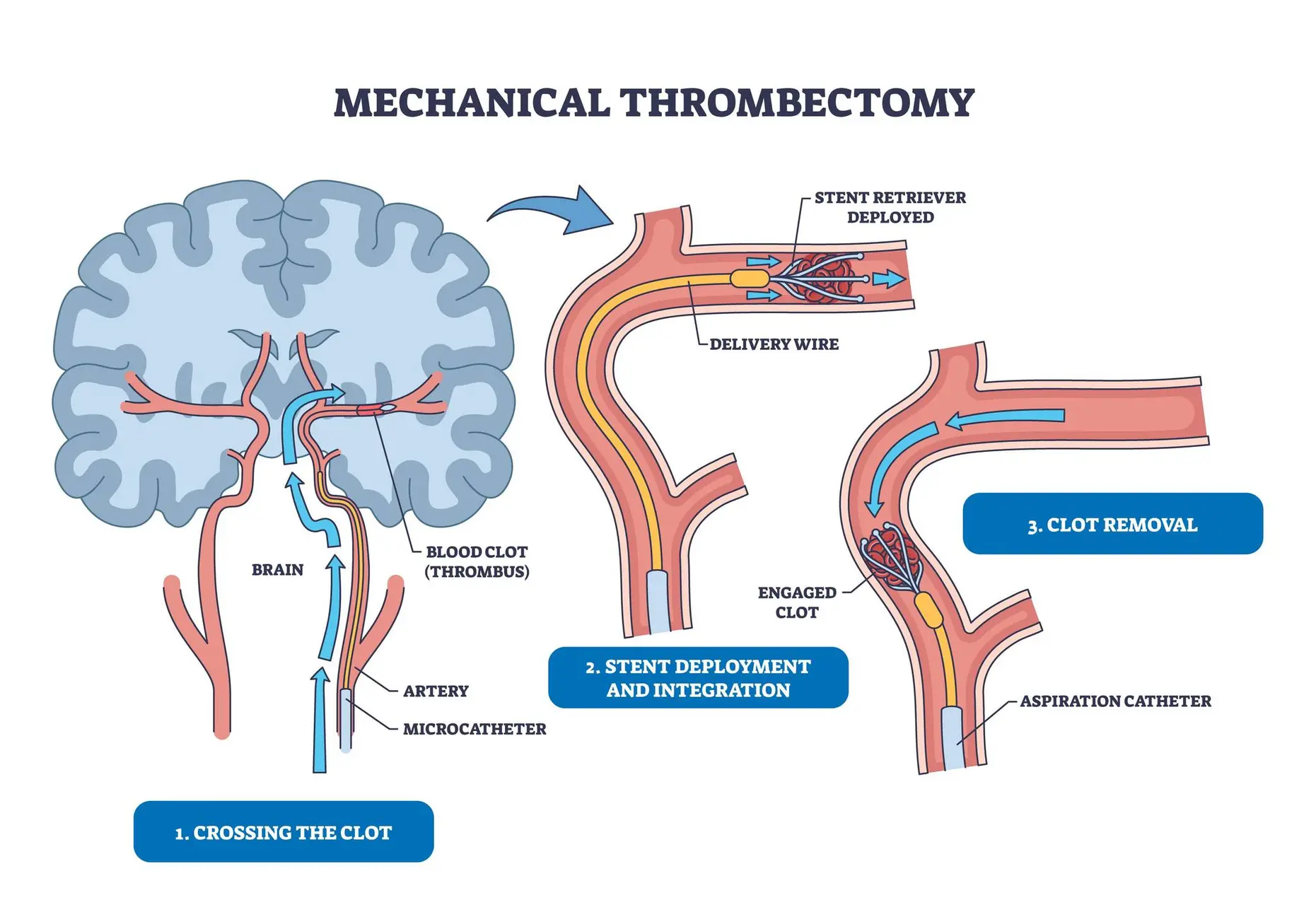
Mechanical thrombectomy added to medical treatment did not improve 3-month functional outcomes in adults with acute ischemic stroke caused by a primary, isolated medium or distal vessel occlusion and was associated with more hemorrhagic complications, according to the DISCOUNT randomized clinical trial published in JAMA.
The trial enrolled 244 participants at 22 stroke centers in France from November 2021 through April 2025. Eligible adults presented within 8 hours of symptom onset or within 24 hours of when they were last known to be well if fluid-attenuated inversion recovery imaging showed no hyperintense signal. Participants were randomized to thrombectomy plus medical treatment (n=123) or medical treatment alone (n=121).
The primary endpoint of the trial was a good clinical outcome at 3 months, defined as a modified Rankin Scale score of 0 to 2 and assessed by an independent, blinded evaluator. The participants’ median age was 75 years, 56% were male, and the median National Institutes of Health Stroke Scale score was 8.
At 3 months, a good clinical outcome occurred in 72 of 116 patients (62%) assigned to thrombectomy and 81 of 119 patients (68%) assigned to medical treatment alone. The difference was not statistically significant. The adjusted absolute difference was −6.8 percentage points.
The trial was stopped after a planned interim analysis because of futility and an increased incidence of symptomatic intracranial hemorrhage. Symptomatic intracranial hemorrhage occurred in 11% of patients who received thrombectomy compared with 3% of those who did not. Mortality did not differ significantly between the groups (6% vs 8%; P=.49). The authors concluded that the findings do not support routine thrombectomy for this patient population.
Sources: Clarençon F, Bala F, Baptiste A, et al. Mechanical thrombectomy in ischemic stroke with a medium or distal arterial occlusion: the DISCOUNT randomized clinical trial. JAMA. Published online July 22, 2026. doi:10.1001/jama.2026.8977
Advertisement
Today's Joke
Cartoon Slide Show
Quiz
Medical Trivia 9/9/2026
1 questions · ≈ 1 min
to compete in the ranking.
×
Loading