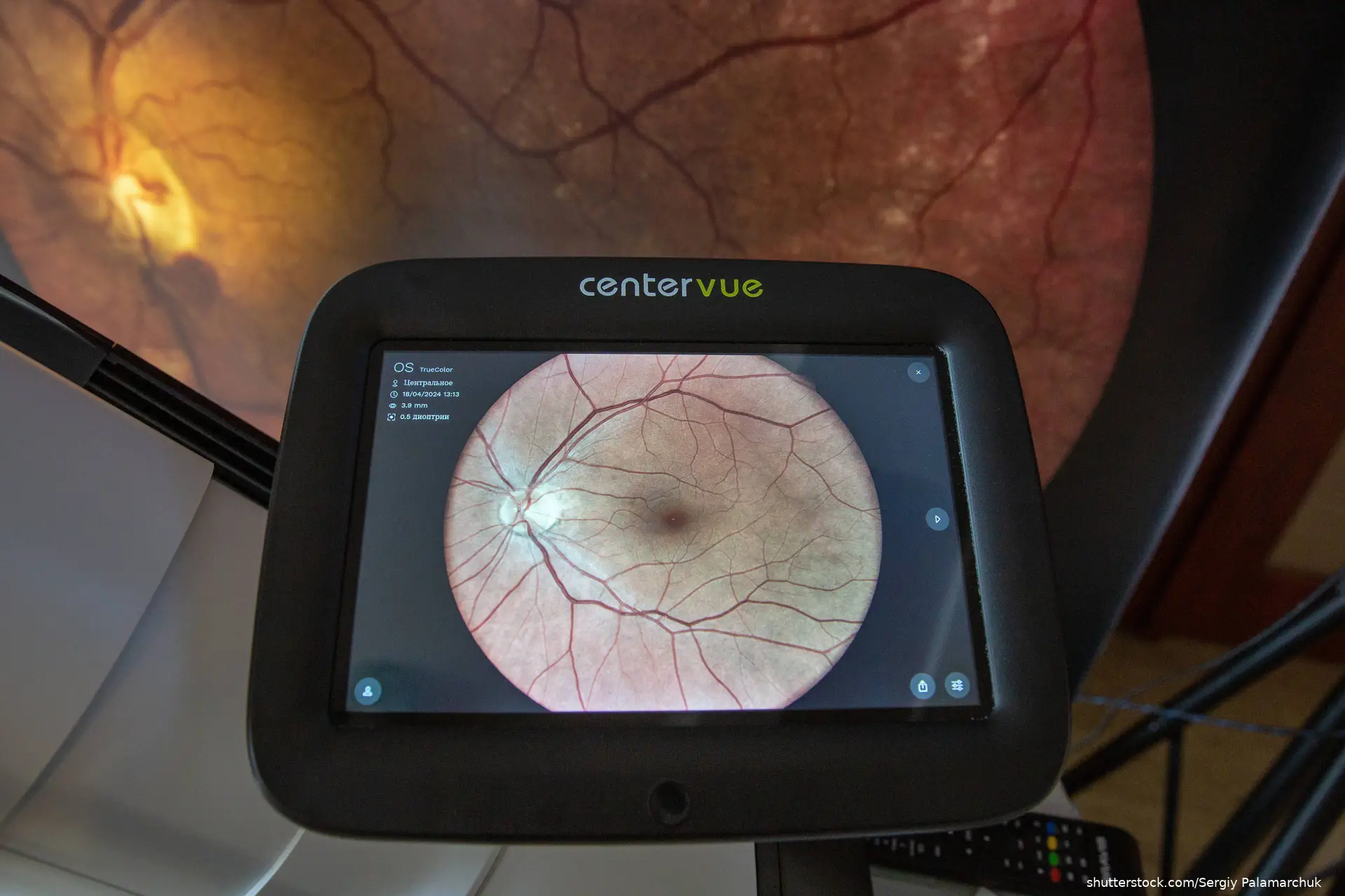
A deep learning classifier for referable diabetic retinopathy (DR) trained on tabletop fundus photographs largely retained its ability to separate referable from nonreferable eyes on images from other cameras, but its predicted probabilities became miscalibrated, according to a study published in Scientific Reports.
The authors noted that DR screening increasingly runs on handheld and smartphone-based devices whose images differ from those used to train models, and that referral thresholds and triage rules depend on calibration, the agreement between predicted probability and observed frequency of disease.
The investigators trained 2 convolutional networks, 5 times each, on 16,242 tabletop images from the BRSET dataset and applied them without adaptation to 4,884 handheld images (mBRSET) and 3,662 images from an independent external dataset (APTOS 2019). Referable DR prevalence was 5.7%, 17.6%, and 40.6%, respectively. Without retraining (zero-shot) area under the receiver operating characteristic curve (AUROC) ranged from 0.89 to 0.96, within 0.03 to 0.04 of networks trained directly on each target dataset.
However, a decision threshold set to give 90% sensitivity on the source data detected only 42% to 47% of referable cases among handheld images. The investigators attributed about four-fifths of the calibration loss on handheld images to the higher disease prevalence; on the external dataset, prevalence and other dataset differences partly offset each other. Correcting for prevalence without labels did not restore calibration, whereas recalibration with 100 to 200 labeled target images did. Half-precision models preserved discrimination and calibration, whereas 8-bit integer quantization reduced discrimination.
The authors noted that the source and handheld datasets came from the same national consortium and grading protocol, that the external dataset contained duplicate images with inconsistent grades, that calibration was not assessed in demographic subgroups, and that the triage analysis was a retrospective simulation. They concluded that new cameras require recalibration on local labels and cautioned against generalizing the findings to other populations without prospective validation.
Source: Tabibu S, Abhyankar M. Discrimination transfers but calibration does not across fundus cameras in diabetic retinopathy screening. Sci Rep. Published online November 14, 2026. doi:10.1038/s41598-026-78618-8
Advertisement
Today's Joke
Cartoon Slide Show


Quiz

Medical Trivia 11/24/2026
1 questions · ≈ 1 min
to compete in the ranking.
×